England 0-1 Japan : Tactical Dominance by Samurai Blue
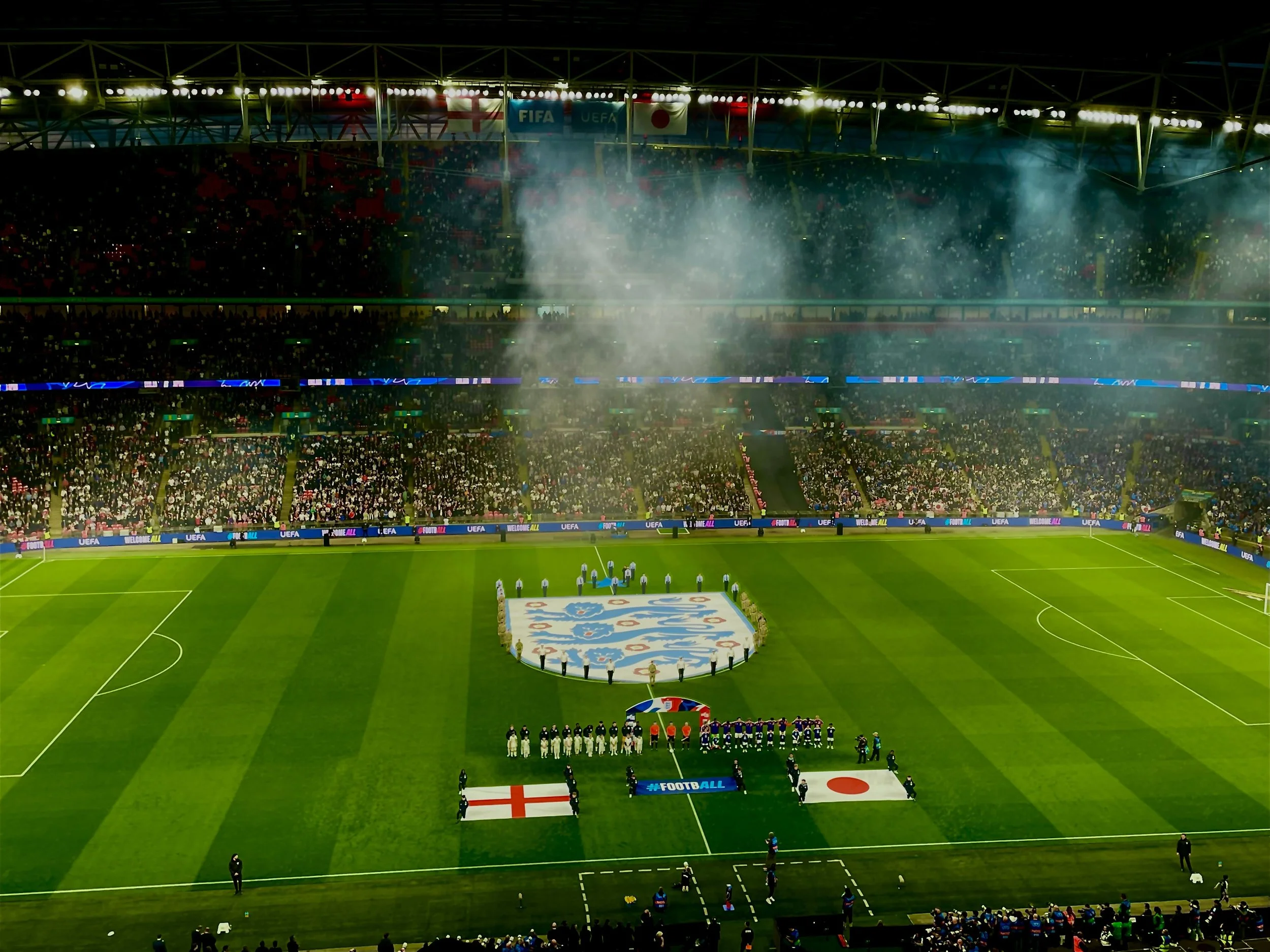
Japan made headlines over the recent international break by becoming the first men’s Asian team to defeat England. From an England perspective, the victory was all too comfortable for Japan, as the three lions were frustrated both in build-up and in front of goal. However, the tactical brilliance of Japan in this match cannot be ignored, with 3 talking points of note from Japan’s gameplan and execution.
1 : The Paradox of Structured Fluidity
On paper, Moriyasu set Japan up in a 3-4-3 system, a familiar shape used by Japan in recent years. However, the fluidity within the system that is usually so structured helped Japan in outclassing the Three Lions.
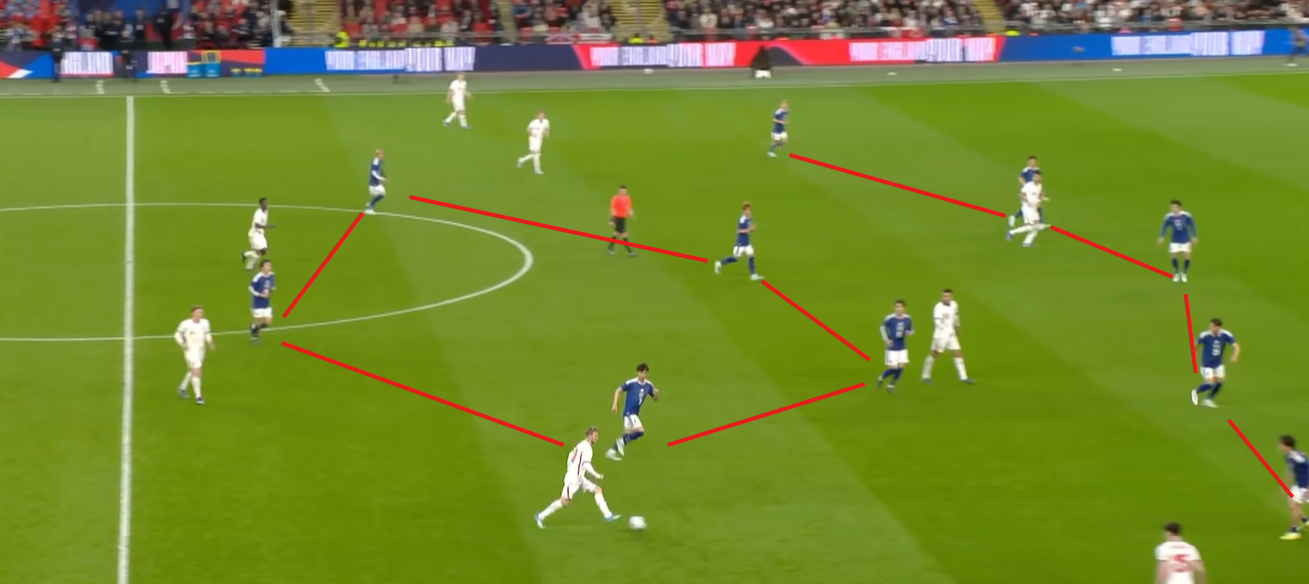
Figure 1 : Japan defensive structure.
Off the ball, Japan were in a low block, more in a 5-4-1 system (Figure 1) with the midfield very tightly packed by the two holding midfielders (Sano & Kamada) and the two wingers (Mitoma & J. Ito). This allowed Japan to nullify Palmer, Foden, and Rogers, players who all prefer to find space within central areas to receive the ball. England’s 4-2-3-1 system with these central players meant they were naturally very narrow, letting Japan trap them inside. Furthermore, this shape also meant passing lanes from Anderson and Mainoo were blocked, who were allowed to have the ball by Japan. This meant England struggled to create through the middle, leaving them to try build up out wide, where there was a double up of the winger and the wingback, or go longer, where there were no meaningful targets to aim at. Gordon was also thwarted by the low block, as he was unable to complete any dribbles due to receiving the ball with limited space from the width of the back 5. This well-structured, disciplined low block meant England created 0 big chances even though they averaged 70% of the possession, showing the resilience of Japan’s defence.
On the ball, this rigid structure dramatically changed at pace, especially on the wings. Whilst playing wingback, both Doan and Nakamura are wide players who prefer to cut inside on their preferred foot. This makes them extremely capable in a 1v1 situation as well as chance creation, which caused England all sorts of problems. The pairings of Mitoma and Nakamura on the left, and Doan and J. Ito on the right constantly interchanged in build-up, leaving both O’Reilly and White often drawn out or losing their men. There were times when Mitoma received the ball off H. Ito (LCB) with Nakamura higher up, and also times when they played very close together with quick interchanges to get past O’Reilly on the left. With two wingbacks who like to take their men on, Japan’s quick counters drew England out of shape and freed up space for teammates to create. England, who committed many men forward, were completely outdone in turnover situations, as Japan played quick passes with fluid movements to flow past the helpless England midfield and defence.
For example, Japan turned the ball over in the 53rd minute and quickly moved the ball across to the right-hand side. The structure is interesting here, as Japan’s fluidity is in full flow.
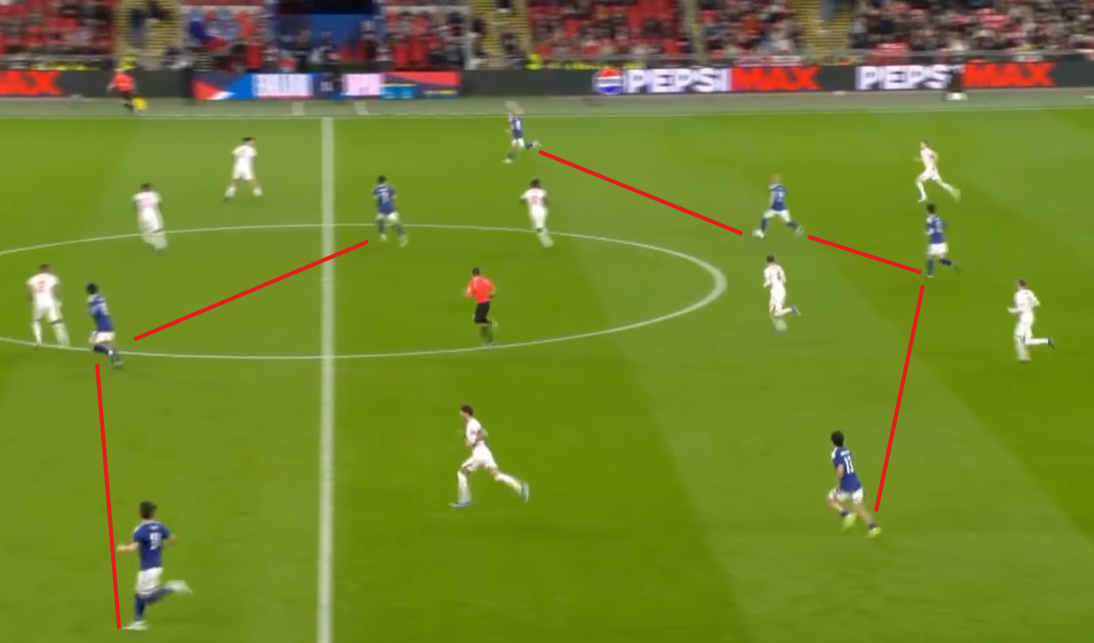
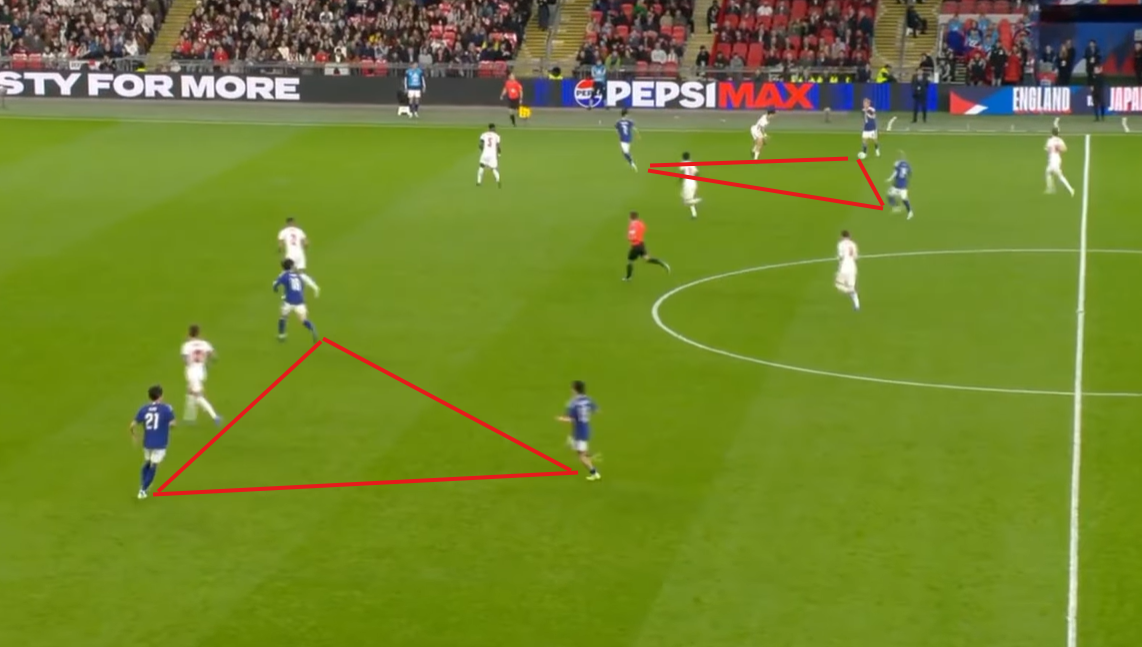
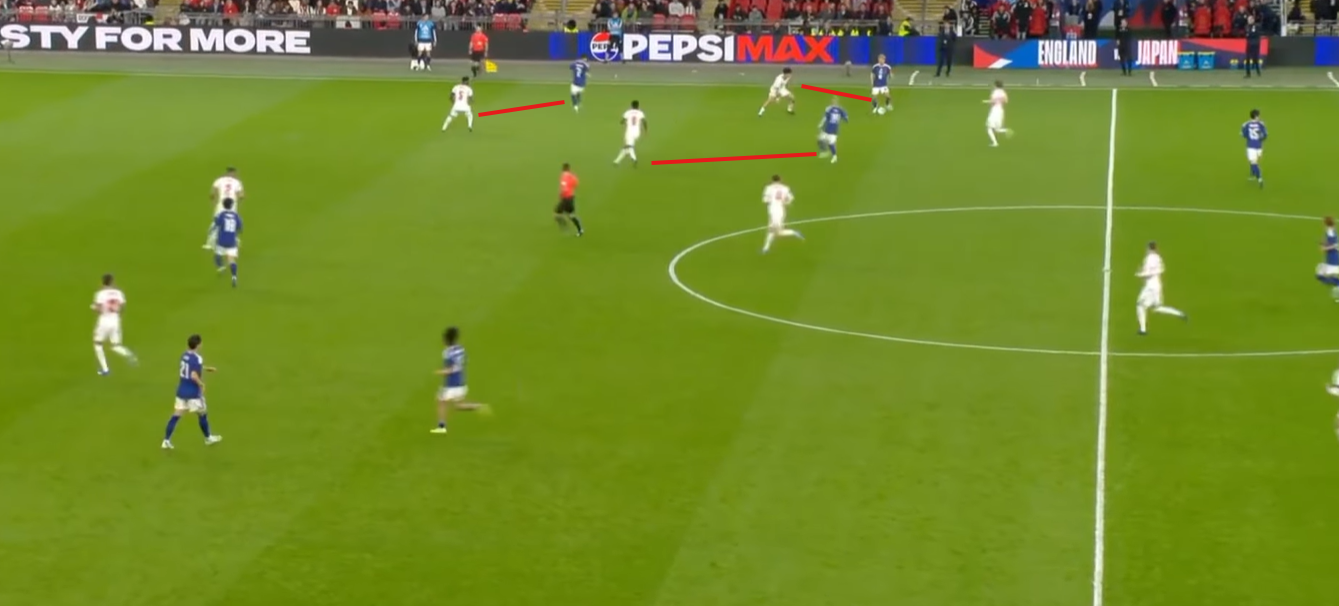
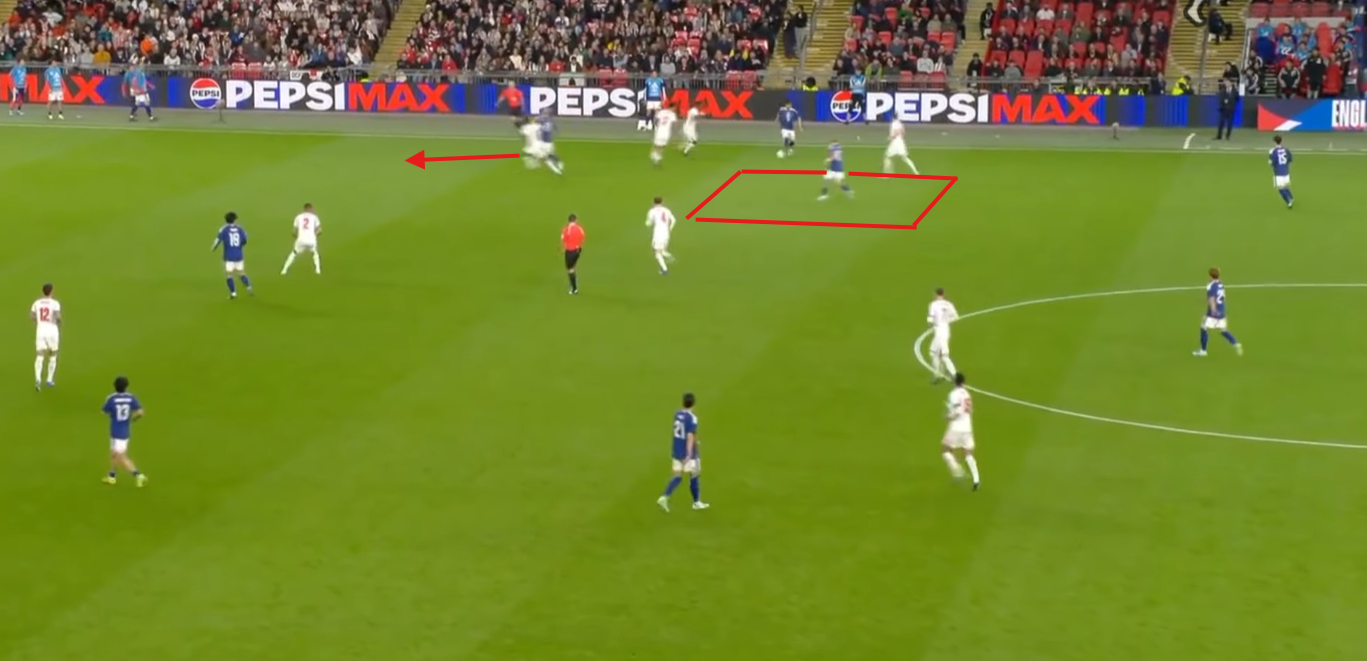
In Figure 2, we can see Japan’s 3-4-3 shape still intact, yet with wildly different personnel. The front 3 consists of H. Ito marauding from LCB, Ueda, and Mitoma who transitions to the right-hand side. J. Ito drops into the midfield two alongside Kamada, whilst Doan and Nakamura maintain their wingback positions. The 343 allows for triangle combinations on the wings, which Japan exploit (Figure 3). This allows the players to move off the ball whilst maintain their triangular structure on the wings, beating England’s tight man-for-man press (Figure 4). Doan receive the ball and in doing so draws out O’Reilly, who then ball watches and follows the pass to J. Ito. This draws Guehi to Mitoma, who is free on the right wing. Ito then immediately makes a darting run underlapping Mitoma and dragging Mainoo with him, which creates Doan space to receive the ball in acres of space. (Figure 5).
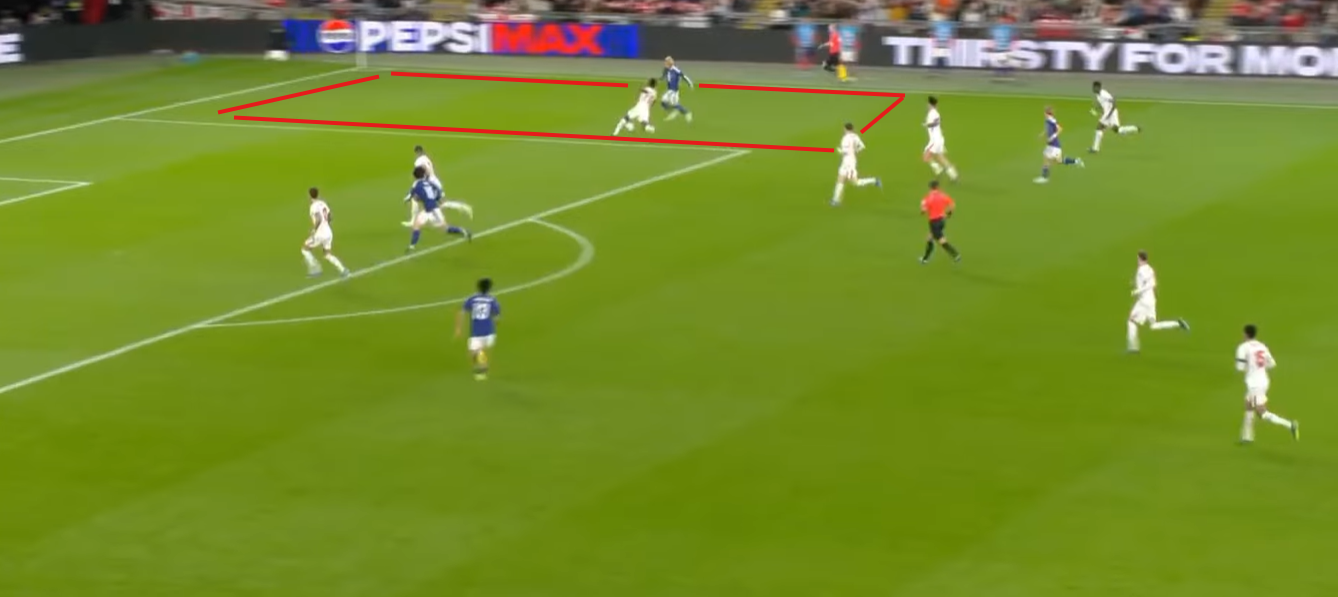
Figure 6 : J. Ito 1 v 1 space.
Doan can then pick out a pass to J. Ito, who has a lot of space to take Mainoo on in the 1 v 1 (Figure 6). Japan clearly sought to isolate these 1 v 1 situations, as they trust their winger or wingbacks to beat their man and deliver or shoot. England’s defensive shape completely was outmanoeuvred by intelligent movement off the ball and quick interchanges.
This takes us onto the goal, which was a further depiction of a fluid turnover.
2 : Mitoma (23’)
Japan’s goal comes from both the rigid low block and the fluid counterattack combining into one, perfectly executing their game plan.
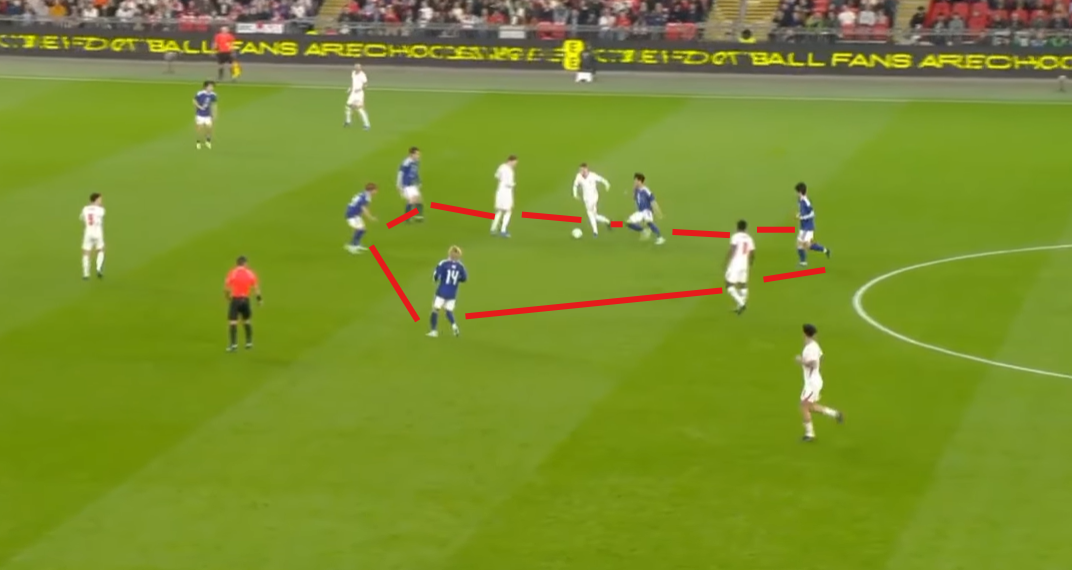
Figure 7 : Palmer outnumbered by Japan.
In Figure 7, we see the defensive shape when Palmer collects the ball in the middle, surrounded by the tight packed Japanese centre. Japan are able to win the ball back comfortably, before exchanging quick one touch passes and allowing Mitoma to eventually drive with the ball.
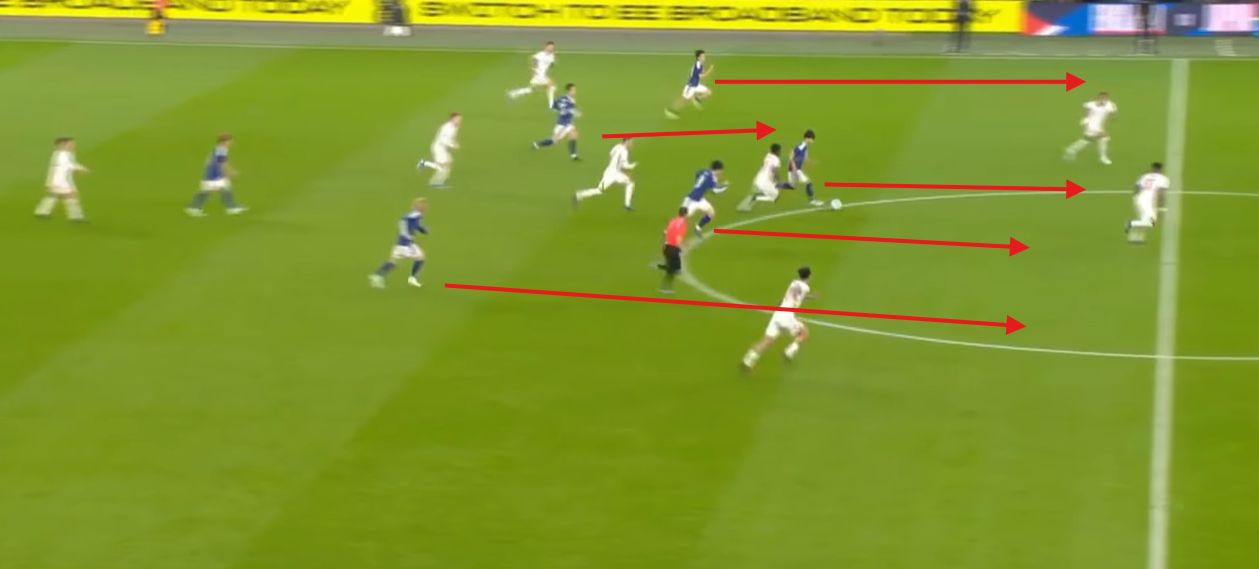
Figure 8 : Japan committing numbers forward.
In Figure 8 we can see clearly the numbers that Japan commit in their attacks as they look to displace the England structure. Mitoma is able to draw men in with his excellent ball carrying, before releasing Nakamura (LWB) on the left with acres of space, vacated by White who could not catch Nakamura whilst tracking back.
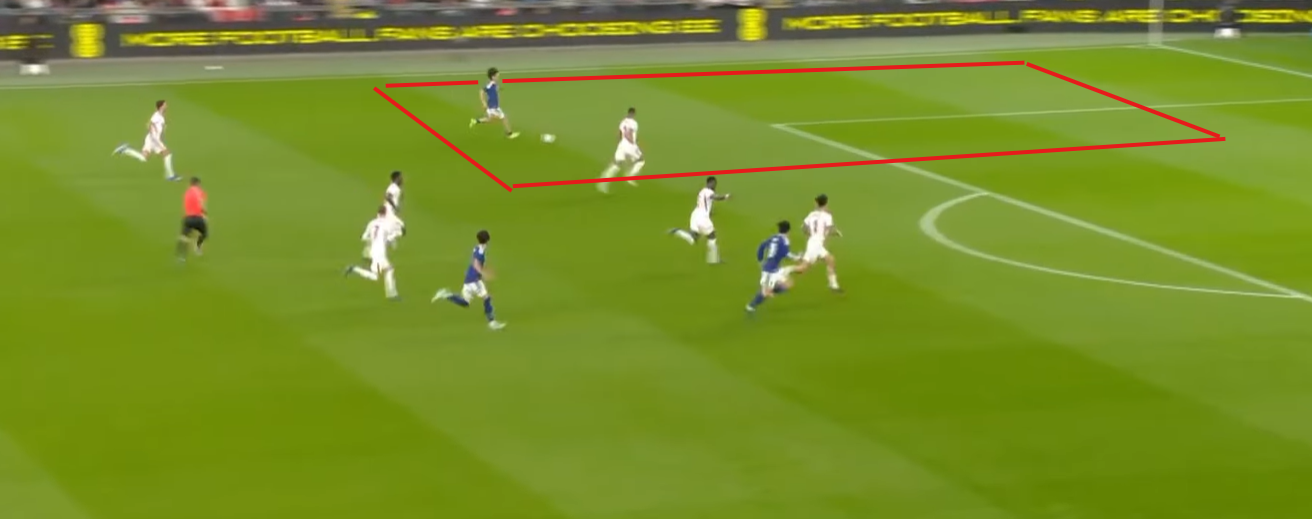
Figure 9 : Nakamura 1 v 1 space.
Japan are able to create an abundance of space for Nakamura, isolating Konsa into a 1v1 situation, who Nakamura has the confidence to beat (Figure 9).
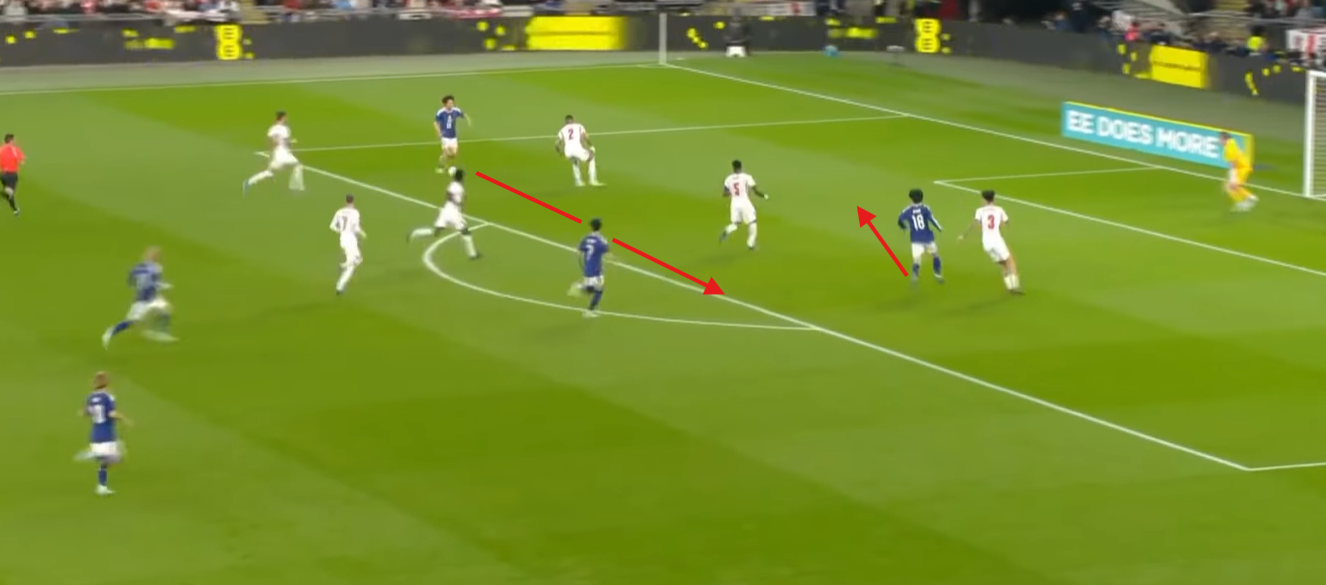
Figure 10 : Mitoma’s goal (23’).
Mitoma, who was able to carry the ball past the England midfield, is now unmarked on the edge of the box, and slots it away after a return pass from Nakamura (Figure 10). Whilst it looks easy, all the cogs of Japan’s gameplan had to be executed to perfection for this goal to work. England were carved open by quick technical play, astute dribblers, 1v1 isolation, and quick offensive transition.
3 : Unselfish Ueda
Another key cog in the goal was Ayase Ueda, who although limited to chances, played a big role in the game.
Ueda worked tirelessly on and off the ball, which may be going under the radar due to not grabbing the headlines like Mitoma. Firstly, if we look back on Figure 10, we can see that Ueda’s movement draws O’Reilly just enough for Mitoma to have space to score. Ueda uses his strength in movement to become a decoy, a selfless action in a beautiful team goal.
Ueda’s movement was relentless all game, where he came towards the ball to draw out Guehi or Konsa to create space for the wingers and wingbacks in the channels. Although limited to 17 touches, what he did without the ball was arguably more important, as he occupied two top class centre backs.
His defensive work was also excellent, completing 3 recoveries, 2 deep in his own half. He held his defensive shape, not over committing in order to allow his teammates to also hold their structure. He became the first defender in the system.
As a striker, it can be undoubtably frustrating to be limited in chances, but the humility and selflessness of Ueda allowed the rest of the team to play to their strengths. Furthermore, on another day he would be walking away with a goal, as he was unlucky to hit the crossbar after finding a lovely pocket of space between Guehi and Konsa.
You can read more about Ayase Ueda in my previous piece ‘Ayase Ueda - The Japanese Inzaghi’.
Key Takeaways
Whilst only 1-0, it would be harsh on Japan and Moriyasu to call this game a simple smash and grab. England were frustrated by the hard-working Japan, who executed their game plan to perfection. The confidence that oozes from the Japanese is clear to see, as they have a fearlessness in attack that England seem to lack at times. 0 big chances for England shows a lack of responsibility and willingness to take risks, something Japan did in abundance. Japan were also comfortable in their low block, showing that they are a real threat at the World Cup. The so-called top nations should be looking over their shoulder at the fearless force of Japan, who have shown they are not just underdogs, but serious contenders, due to their tactical brilliance and commitment.