Ayase Ueda - The Japanese Inzaghi

Ayase Ueda has quietly been taking the Eredivisie by storm this season, netting 22 goals in 26 matches for Robin Van Persie’s Feyenoord. His poacher’s instinct and style of play draw similarities to Italian legend Filippo Inzaghi, who had the knack for being in the right place at the right time. Ueda, who is now 27 years old and in what looks to be his prime, is in line to be the starting striker for Japan at the upcoming 2026 World Cup. However, his sudden blistering form raises the question of whether he is as good as his numbers suggest, or just a one season wonder.
We must begin by looking at his numbers. Last season (24/25), he scored a rather average 7 goals in 21 games in the league, which is nowhere near as efficient as is output this season. The season prior to that (23/24), he had 5 goals in 26 league games. Now in his third season in the Eredivisie (25/26), he is in his best form compared to any other season in his entire career, including his time in Japan at Kashima Antlers. Furthermore, for Japan, he has netted 8 and assisted 2 in just 9 games in 2026, showing that his form has carried through to his national team performance. But why, this season, has everything clicked for him?
There are two key reasons for his outstanding performances this season. Firstly, his tactical comfortability within Van Persie’s system that directly caters to his strengths has allowed him to finally show his quality. Van Persie’s system is very offensive, focusing on offensive overloads on the opposition defence. In the 4231 shape, Feyenoord are often able to get into promising opportunities from quick build up patterns.
For example, in Feyenoord’s impressive 6-1 victory against PEC Zwolle, Ueda was able to score 4 goals, with his second being a direct result of Van Persie’s tactics.
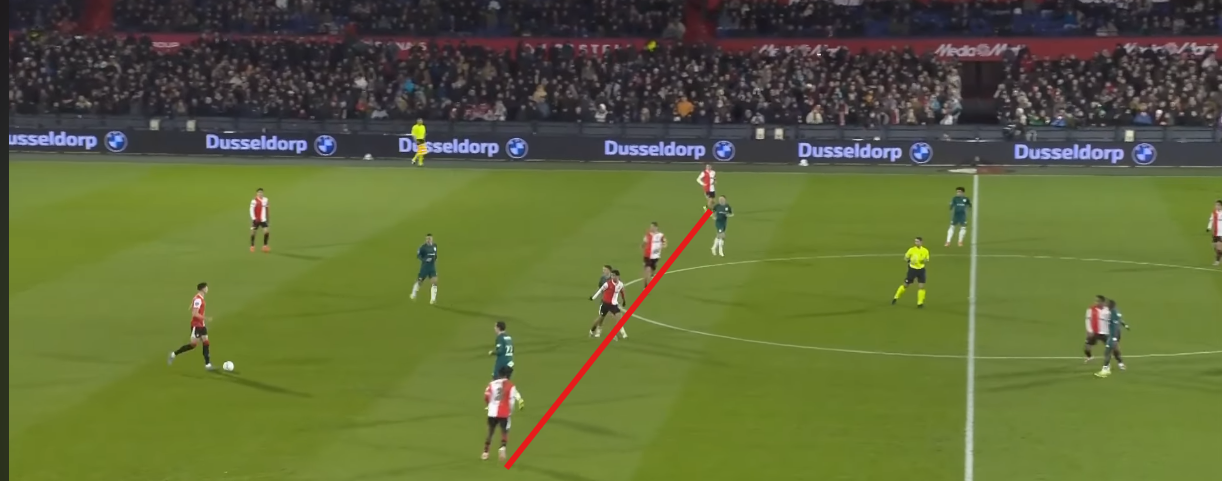
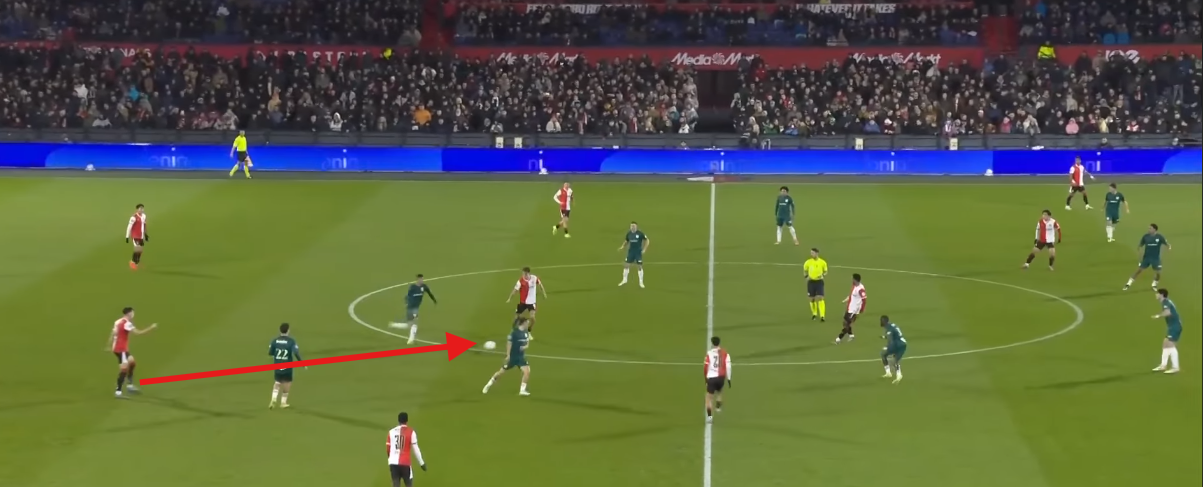
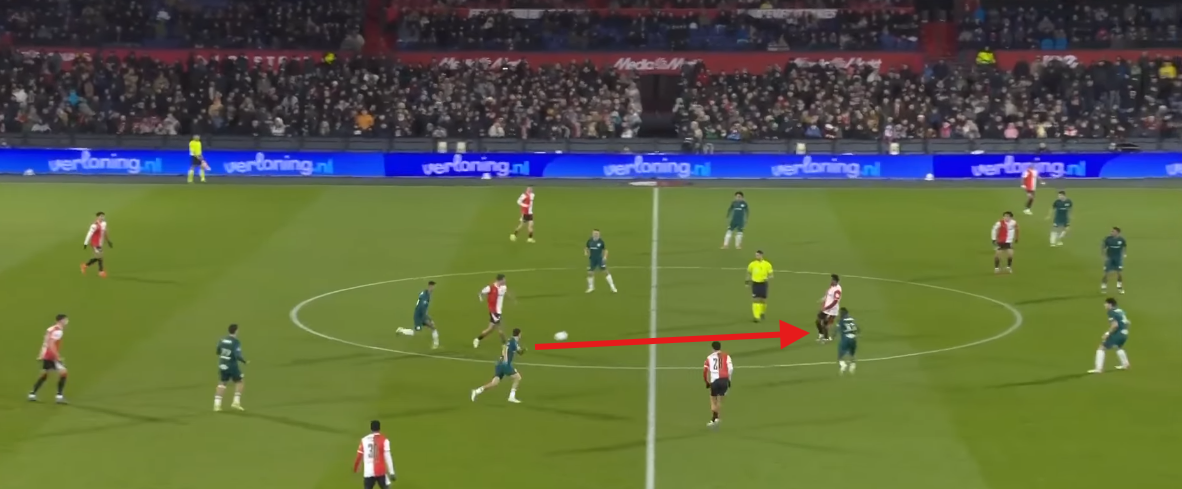
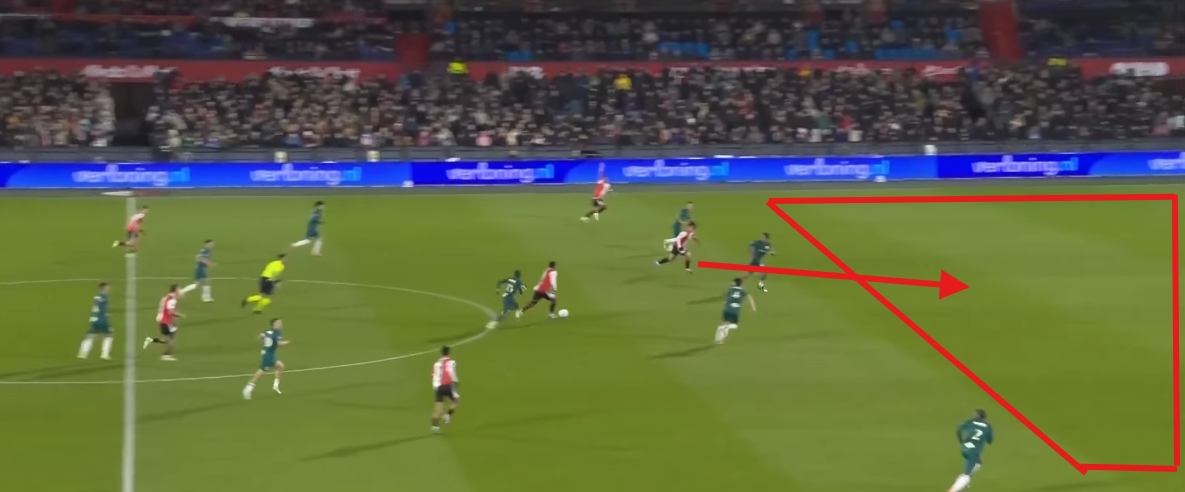
In Figure 1, we see that the build up structure is in a 2-4-1-3 shape, with the fullbacks being in line with the two holding midfielders. This outnumbers the PEC Zwolle press in the middle, freeing up Targhalline (RDM) for the pass (Figure 2). This space created by structure allows Targhalline to turn and pass quickly to Timber (CAM), who can receive the ball on the half turn and face the direction of play (Figure 3). On this instance, Ueda drops off the defence slightly as if to show for the ball, while the two wingers stretch the play. This allows for acres of space to exist behind the Zwolle backline. As soon as Timber turns, Ueda uses his strength of intelligent runs to dart into the space the team has created for him (Figure 4), where Timber has all the time in the world to pick out a pass in behind the defence, eventually resulting in a goal. This goal is a key example of why Ueda is scoring so often. One of his strongest attributes is his off-the-ball movement both in and outside of the box, as he drifts in and out of the spaces around the defensive line. His decision making and speed to make the run into the space created by Feyenoord’s quick build up allowed for him to score this goal, making him and the system interdependent. We can see that he has a real striker’s instinct and unbelievable quality that could lead him to become a regular goalscoring machine over the next few years.
Ueda’s off the ball movement is also excellent in the box. Both his shot map and goal map (Figure 5 & Figure 6 below) show 78/88 shots have been from inside the box, whilst all but one of his goals have been scored from inside the box in the Eredivisie this season.
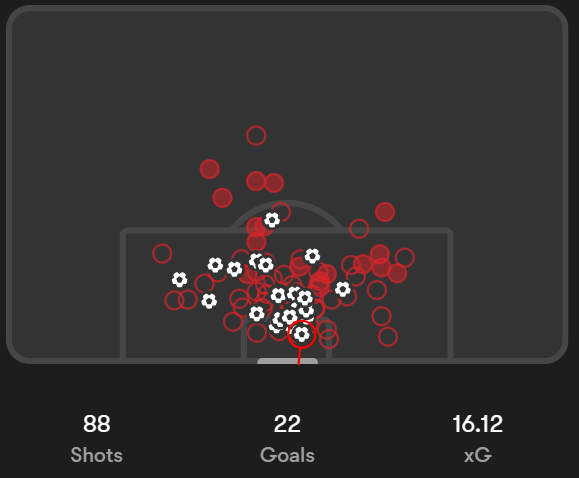
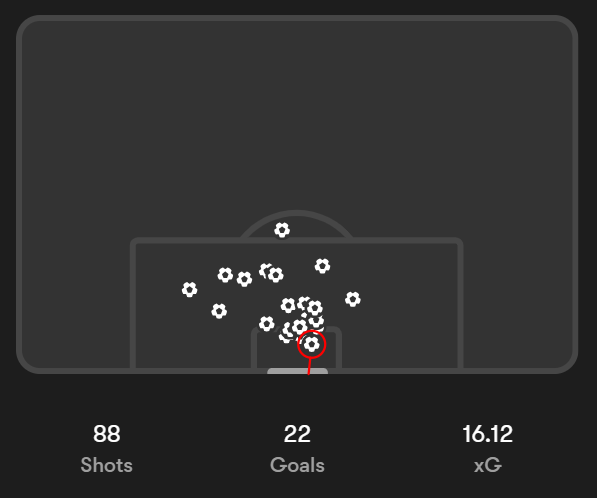
Most of his goals are in and around the 6-yard box, with 8 being headers. This suggests an elite sense of understanding within the box of where to be and where the ball will be. Feyenoord also play to this strength, with the most touches in the opposition box (1,047) and also 4th for successful crosses p90 (5.3). Once past the first phase of play, Feyenoord like to overload the forward line, with the midfielders pushing high to support Ueda in and around the box, leaving Ueda often unmarked or at least with enough space to use his intelligent movement. His goals against NAC Breda or Excelsior, for example, are both real poachers finishes, where he gets on the end of a loose shot or pass where he is in the right place at the right time. This goalscoring trend is similar to Italian goalscoring legend Inzaghi, who relied on his spatial awareness to score so many goals for club and country.
An example of this elite movement can be seen in his goal against Volendam.
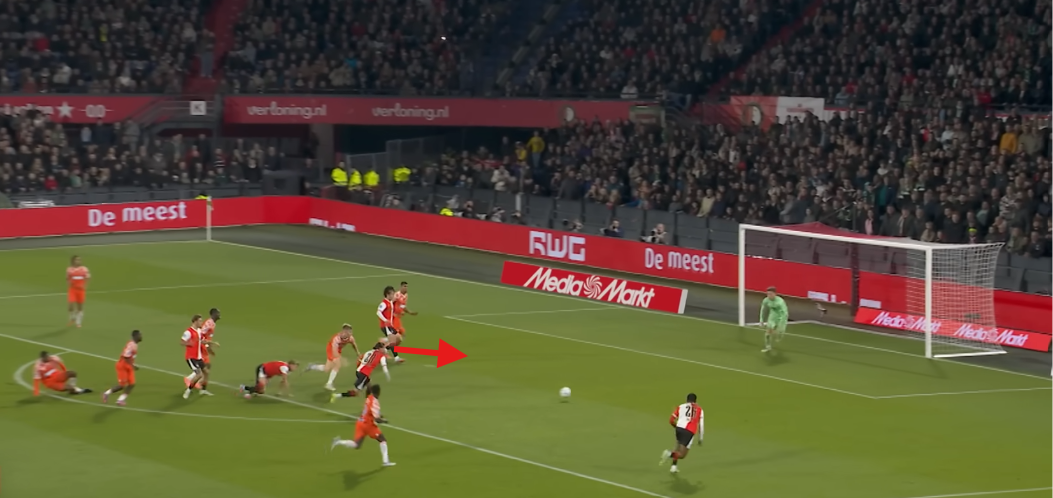
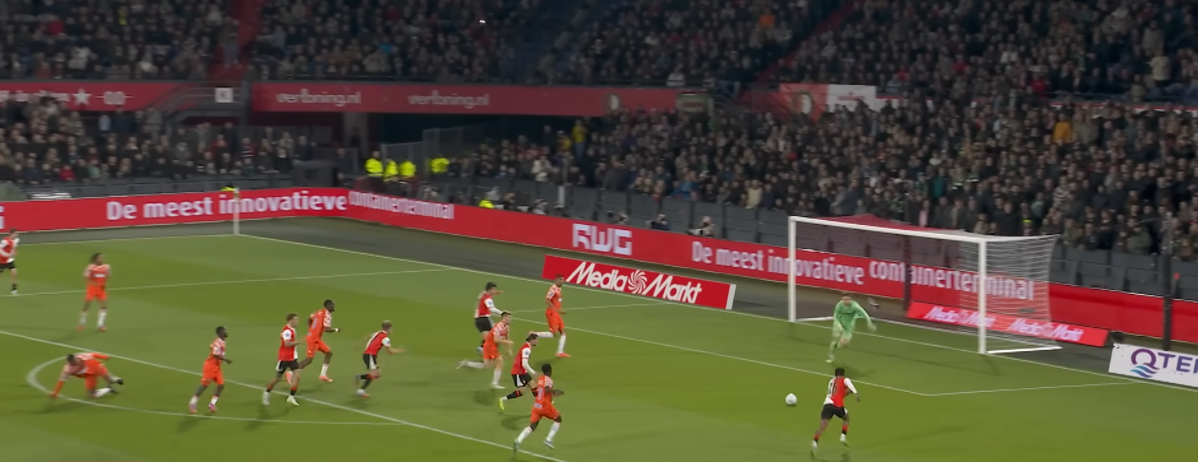
As the ball goes out wide and the players prepare for a cross, Ueda makes a darting run in front of the defender, letting the defender know he is there and putting him in a false sense of security (Figure 7). Then in blink of an eye, he drifts behind the defender, giving himself enough space for him to score (Figure 8). His movement is a handful for the Eredivisie, and whilst it looks simple, takes high concentration and understanding to know where the ball will be for him to finish. Feyenoord’s style of play that is spearheaded by Ueda’s elite game awareness, where both cogs work interdependent on one another, is why he tops the Eredivisie charts for goalscoring.
The other key reason for his stellar campaign is trust. He is simply playing more and relishing being the starting number 9. He has already near matched his total minutes across his two previous seasons this campaign, where he played second fiddle to Santiago Gimenez. Most strikers rely on form and consistency to score goals, which you cannot achieve if you are in and out of the team and constantly being used off the bench. Ueda is now the leading man of the Feyenoord attack, as Van Persie puts his trust in him to score his goals. He now comfortably outperforms his xG, whilst also averaging 3.79 shots p/90, showing his confidence in front of goal. Psychologically, he has found his feet due to the trust Van Persie has put in him to be the main man.
Whilst his overperformance of xG may suggest that he may just be a striker on a rich vein of form, Ueda has shown more than enough quality to suggest that he is a top striker who is ready for the top 5 leagues. It is easy to say his goals are fortunate, and that it is just a purple patch, but his play that are not shown in statistics suggest a different story. Whilst we can clearly see a clinical finisher, his awareness of the space he has, his understanding with his teammates, and his overall poacher’s instinct all point to a potentially world-class centre forward. There is enough evidence to say that he most definitely lives up to what his stats suggest him to be.
The 2026 World Cup will be a big tournament for him, as he will most likely be the starting centre forward for his country for the first time, like his season at Feyenoord. Whilst at Feyenoord, tactics have played a big part in his success this season, international football is a different type of game. Form is key, and there is arguably not a striker in the world besides Haaland and Kane currently having a better season than Ueda. With key players such as Minamino potentially out for the World Cup, Ueda has the chance to step up and become the hero of his country. Japan should be quietly confident of their chances in the competition if Ueda can bring his form from his domestic campaign to the biggest stage.
The World Cup will also be an opportunity for Ueda to show the world his true ability. It will be a chance to impress potential suitors for the upcoming season, as his remarkable campaign for Feyenoord has no doubt caught the attention of top clubs across Europe’s top 5 leagues.